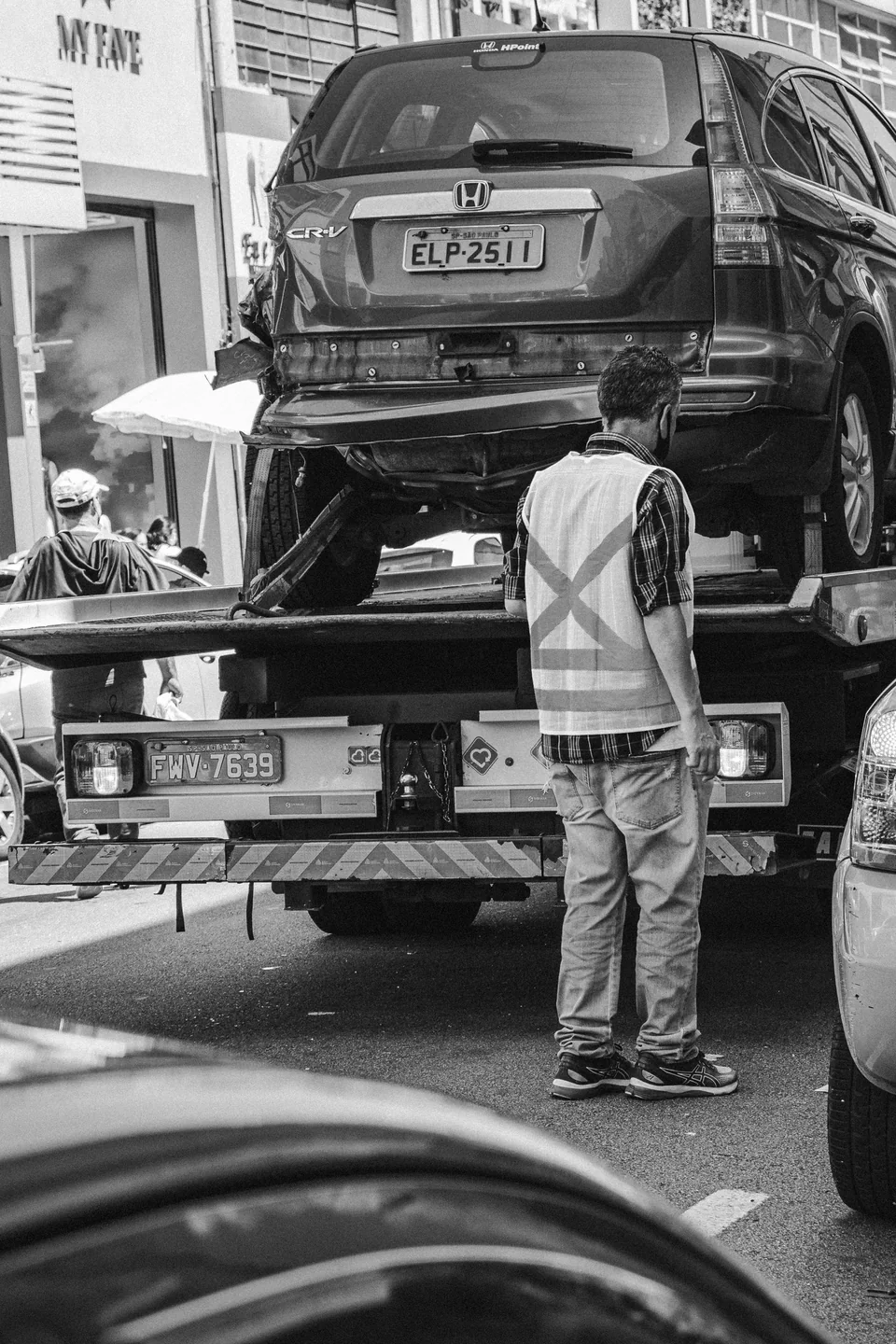
Call the yard for the location, itemized balance and release requirements. Send that information to the insurer and name who will arrange inspection, authorize movement and book the truck. Confirm the destination can receive the car, then verify pickup happened. An open claim does not arrange transport by itself.
What you can do with this guide
- Get the current balance and release conditions from the actual yard.
- Name the person booking transport; approval alone is not a pickup.
- Verify the move happened and retain the final invoice.
Your car is behind a gate. The tow yard wants instructions. The insurer says someone will call. Meanwhile, you still need transportation and may be facing another storage charge.
The first goal is a confirmed next move: where the vehicle is going, what must happen before release, and who is actually booking the truck. A claim number, an approval and a pickup appointment are three different things.
Use this guide to turn the calls into one workable plan. Release documents, storage rates, holds and dispute routes depend on the location; the state and city examples are labeled. Start with the car's actual situation, not a fee or deadline found for another state.
When the yard, insurer and shop are each waiting for someone else
Ask each business to finish the same sentence: “The next thing we need before the car can move is ___, from ___.” Put the answers together. You may discover that a repair shop is ready but the yard has never received the release, or that the insurer approved transport without dispatching it.
Create one short move record with five entries: current location, release obstacle, next destination, person booking transport, pickup confirmation. Add a contact and a requested update time to every open item. This is your coordination note, not an authorization to repair, sell or dispose of the vehicle.
Example: the adjuster says pickup is approved, but the yard says it needs the owner's signed release. Ask for the correct release form, read its scope and send it through the yard's verified route. Then ask the transport contact for a booking confirmation. Sending the release resolves one obstacle; it does not prove a truck has arrived.
If an inspection or preservation request is outstanding, include it in the plan before moving or altering the car. If a sale or lien notice arrives, keep that notice and address its stated process promptly instead of assuming the insurance discussion has put it on hold.
The first calls: locate, document, coordinate
If you are still at the scene, prioritize safety and emergency care. Once you can deal with the vehicle, use this checklist yourself or ask someone you trust to help gather information. Do not send them to collect the car until the yard confirms what authorization it requires.
- Locate the vehicle. Check the tow receipt. If you do not have it, contact the responding police agency’s non-emergency or records service, or the roadside-assistance provider that dispatched the truck.
- Call the actual storage location. Confirm the street address, vehicle identification, arrival time, current charges, billing increments and release hours.
- Notify the claim handler. Give the insurer the yard’s details and say explicitly that the vehicle is accruing storage charges, if that is what the yard confirms.
- Agree on the next action. Identify who is arranging inspection, who can authorize movement, the intended destination and the expected pickup time.
- Follow through. Confirm that the vehicle was collected and received. Save the final invoice rather than treating an authorization email as proof the move happened.
The NAIC’s claim guidance recommends reporting a claim promptly, cooperating with the adjuster’s investigation and keeping dated notes of conversations. Use that record to connect the people handling the car, not simply to record that you called.
Confirm the location and any hold
Have the plate number, make and model, crash location, date and police incident number available. Ask whether the car is at the original destination or has been transferred. A tow company’s office address may differ from its storage lot.
If the agency cannot find the vehicle immediately, ask which unit maintains tow records and when a record may become available. Write down the person’s name and next step. Do not assume an unfamiliar yard is legitimate just because someone texts a payment link; confirm its details against the dispatch or agency information you obtained.
Also ask whether there is a police or investigative hold and which agency controls release. For example, Portland Police’s towing instructions say vehicles on investigative hold do not appear in its public locator and direct owners to the investigative unit. That is a Portland procedure, but it shows why “not found online” does not necessarily mean the car was never towed.
A yard employee’s availability and the legal ability to release a vehicle are separate questions. If a hold exists, obtain the agency’s contact and release instructions before scheduling another truck.

Find out what the yard is charging and what stops release
Request a copy of the tow ticket and an itemized current invoice. Ask for a quote through the proposed pickup date and time, including how another billing period begins. Do not rely on a single total without knowing what date it covers.
On a phone, swipe across the table to read both columns.
| Ask for | Why it matters |
|---|---|
| Tow and storage charges separately | Shows what was charged for transport and what continues to accrue. |
| Arrival time and billed storage periods | Lets you compare the bill with the actual timeline. |
| Other charges and their descriptions | Identifies recovery, notification, administrative or other items that need explanation. |
| Release hours, documents and payment methods | Prevents a failed trip or truck dispatch. |
| Authorized pickup contact and process | Connects the yard with the insurer, owner or transport company. |
| Any hold or unresolved release condition | Identifies what must be resolved before movement. |
Texas provides a specific example: the Texas Department of Licensing and Regulation says consumers whose cars were towed from traffic accidents are entitled to a tow ticket, and nonconsent tow charges must be itemized. That does not make Texas’s fee schedules applicable elsewhere.
If a number changes between calls, request the updated invoice and reason. Preserve both versions. A disputed item and additional undisputed storage can exist at the same time; identify each rather than refusing to discuss movement until every question is settled.
Get the insurer to name the next action and responsible person
Send the yard’s information and bill to the assigned adjuster or claims contact. Ask which coverage or claim is being considered, whether towing and storage have been authorized, and whether the insurer will pay the yard directly or expects you to seek reimbursement.
Do not assume the other driver’s insurer has accepted responsibility just because it opened a file. Texas insurance guidance distinguishes your own coverage from a possible payment by another driver’s company and warns about expensive towing arrangements. Read its towing-scam advisory; then ask your insurer how your actual policy and claim apply.
Ask these questions in the same message:
- Is an inspection needed before the car moves, and who will schedule it?
- Can it be inspected at the proposed destination instead?
- Who will authorize the pickup and book the transport?
- Which charges are approved, and which remain under review?
- Is there a storage-payment cutoff? Please send the date and basis in writing.
When no adjuster has been assigned, ask the claims service how to escalate a vehicle that is accumulating charges. Give the current daily charge and the yard’s next billing cutoff if known. Save the reference number and time promised for a response.
Separate access to the car from release of the car
Collecting medication, identification or belongings is different from taking possession of the vehicle. So are photographing damage and inspecting it for an estimate. Ask which documents and permissions apply to each task.
For example, Texas vehicle-storage guidance describes free access for an owner or authorized user to collect personal items, subject to law-enforcement restrictions, and access during normal business hours for insurance or repair estimates. Its vehicle-release guidance separately addresses payment and acceptable identity and possession documents. Do not assume another state uses the same requirements.
Before anyone makes the trip, send the yard the proposed pickup person’s name through its verified contact and ask what authorization is acceptable. If the registration or identification is inside the car, explain that specific problem.
Photograph the vehicle and make a list of belongings you collect when access is permitted. Avoid entering an unsafe damaged vehicle, handling sharp debris or trying to remove damaged components. Ask yard staff how safe access can be arranged.
Can someone collect your belongings while the car stays in the yard?
Tell the yard exactly what your helper is coming for. “My sister will pick up my car” sounds like permission to move the whole vehicle. “My sister is coming for the apartment keys and the child’s backpack. The car will stay there” gives the yard a specific request it can check before she travels.
How the paperwork works at a Texas vehicle storage facility. Texas licensing guidance gives an owner or someone who demonstrates a right to possession access to personal belongings without a release fee, unless law enforcement has restricted removal. The facility obtains a receipt listing what the person took. The agency also distinguishes the proof needed to collect belongings from the proof needed to release the vehicle. A bill of sale is one example it gives of evidence that can help with belongings but is insufficient on its own for releasing the car. Outside Texas, ask the applicable facility or local authority what it accepts. Texas guidance on access and belongings.
Ask whether the yard uses the state’s personal-vehicle form for the visit or accepts other proof. The Texas forms directory lists VSF013 for personal vehicles. The form identifies the vehicle, the person appearing, their relationship to the owner and the identification they present. Read the certification and scope with the yard. If all you intend is retrieval of belongings, confirm how that limited task will be recorded. Give identification details through the yard’s verified procedure. A checklist with no ID numbers is sufficient for planning the trip. Texas vehicle storage facility forms directory.
Example. A driver asks a relative to collect a backpack and keys while an insurer is still arranging a tow. Before leaving, the relative calls the facility’s published number, confirms who will be admitted and asks how to access the damaged vehicle safely. At the yard, the backpack is in the trunk but the keys cannot be found. The relative lists only the backpack on the receipt, asks for a copy and records who will follow up about the keys. The owner confirms separately whether the car has moved and which storage charges are still accruing. An item-retrieval receipt cannot establish a vehicle pickup time.
If the yard reports a police hold, ask which agency issued it and whether the restriction covers the particular belongings requested. If staff say the vehicle is unsafe to enter, ask whether they can retrieve the items or arrange supervised access. Print a belongings-pickup plan and receipt checklist.
Coordinate the move without accidentally approving something else
Confirm that the destination has agreed to receive the vehicle. Get its address, contact, operating hours and storage terms. A shop appointment is not proof that the shop can accept a disabled vehicle today.
Then read the authorization. Ask whether it permits transport only, inspection, repair work, dismantling, disposal, title transfer or settlement of a claim. Do not sign a form you cannot distinguish from a broader release. Ask for a copy and an explanation of unclear language before deciding.
The Maryland Insurance Administration’s towing advisory recommends verifying the operator and obtaining a written estimate. Those are useful precautions for a second tow too. Ask what the transfer costs and whether any new storage charge starts on arrival.
Keep inspection and evidence needs in the plan. If a serious injury, disputed crash cause or possible vehicle defect makes the car itself important evidence, tell the adjuster and any lawyer already involved before authorizing repairs, dismantling or disposal. Request instructions about preservation and a suitable location. Do not assume indefinitely leaving it in the original yard is the only way to preserve it.
A simple way to compare the next few days
Illustration only, not a local rate or coverage promise: suppose the existing yard charges $45 for each additional daily period. Four more periods would add $180. A quoted $140 transfer to a location that confirms no storage charge for those four days would cost $40 less over that interval, before any other charges.
That arithmetic does not establish who must pay, whether the quote is lawful, or whether moving is appropriate. Confirm existing release charges, the actual billing increments, the destination’s terms, any hold and the inspection plan. If the receiving location also charges storage, include it in the comparison.
The useful question is not simply “Is a second tow expensive?” It is “What happens next, what does each realistic option cost, and who has approved it?” Keep estimates separate from paid expenses.
Check that the car actually left the yard
Ask the collecting company to confirm completion and the receiving location to confirm arrival. Record the dates, times and vehicle condition. If pickup fails, identify the actual reason: missing authorization, unpaid bill, police hold, inaccessible vehicle, closed destination or dispatch problem.
Send that reason to the person who can resolve it. “The insurer approved the move” does not tell you whether the yard received the document or the truck was booked. Set a specific follow-up rather than allowing each business to wait for the other.
Obtain the final itemized invoice and proof of payment or direct billing. Check that the billed storage period matches the confirmed release time and applicable charging rules. Keep inspection photos, tow tickets, emails, receipts and any notices together.
If repairs or a total-loss decision follow, use the same file for our rental-authorization checklist and total-loss valuation audit. Transportation, storage and vehicle value involve different decisions; approval of one does not answer the others.
Message you can send to the claims contact
My vehicle from the crash on [date], claim [number], is at [yard name, address and verified phone]. The yard reports storage of [amount and billing increment] and a current balance of [amount] through [date/time]. I have attached its invoice. Please confirm the inspection plan, authorized destination, who will book transport, and what release document the yard needs from me. Please also identify any payment cutoff or charges still under review. The yard’s pickup hours are [hours].
Replace brackets only with confirmed facts. If something is unknown, say so. After a call, send a short recap of the agreed action and requested date so a misunderstanding can be corrected.
If the bill or release remains unresolved
Ask for the exact obstacle in writing and contact the appropriate organization: the insurer for coverage, the towing regulator or local agency for towing rules, and the agency controlling any hold for release permission. Portland’s official towing FAQ, for example, separates agency-release questions, towing complaints and court processes. Find the equivalent official contact where your car is stored.
Do not ignore a lien, sale or hearing notice while waiting for an insurance answer. These processes have their own rules and deadlines. This first-calls guide does not determine whether a particular fee is lawful or preserve a legal challenge for you.
Do not let the storage problem swallow the rest of the claim
A tow-yard bill can demand attention every day. If you were also injured, keep the medical and work consequences visible on a separate list: appointments, bills received, days missed and questions for the insurer. The storage invoice explains one expense; it does not summarize the whole accident.
If someone asks you to sign a document to move the vehicle, check what it actually authorizes. A transport instruction, repair authorization, title document and settlement release can involve different decisions. Ask for clarification of any broader wording before signing, and get legal advice about a release you do not understand.
If injuries or disputed responsibility are involved, review the steps for a free injury case review. Bring the tow paperwork and the unresolved injury questions together. For a standalone tow-charge or release dispute, the towing regulator, agency controlling a hold or state consumer resource may be the more direct route; injury-case intake is not a promise of help with every storage bill.
Your next step
Dealing with injuries as well as a car you cannot collect?
The tow bill is one piece of the situation. A free injury case review gives you a place to raise the larger questions about responsibility, records and next steps.
See My Injury Review Options →Free initial review through an independent provider. No obligation to hire.Sources and scope
Core sources checked October 17, 2026; editorial update November 12, 2026. State examples apply only to the named jurisdiction. This guide is editorially researched; it has not been reviewed by an attorney and does not assess your individual claim.
- NAIC — What you should know about filing an auto claim
- Portland Police Bureau — Towing instructions and vehicle locator
- Texas Department of Licensing and Regulation — Consumer information about towing
- Texas Department of Insurance — Avoiding towing scams
- Texas Department of Licensing and Regulation — Access to a stored vehicle
- Texas Department of Licensing and Regulation — Release of vehicles
- Maryland Insurance Administration — Predatory towing advisory
- City of Portland — Towing frequently asked questions
- Texas Department of Licensing and Regulation — Vehicle storage facility forms directory
Spot an error? Contact support@injurylawadvisor.us with the page and source. Please do not email medical records or sensitive case details.